
MOLD CONSCIOUS DESIGN FOR FORCED-AIR SYSTEMS
By Ali McNamara
Forced‑air HVAC systems remain a common choice for residential heating and cooling due to their flexibility and compatibility with a wide range of energy sources, including electric air source heat pumps, geothermal, and fuel-burning equipment. As residential construction continues to prioritize tighter building envelopes, improved energy performance, and occupant comfort, these systems are playing an increasingly central role in maintaining good indoor air quality (IAQ).
One consequence of this shift is a growing risk of moisture accumulation and microbial growth within HVAC components, particularly air handling units. While mold and particulates are routinely addressed in highly controlled environments such as healthcare facilities and laboratories, similar considerations are often not prioritized in residential design. This omission can have a significant negative impact on IAQ, especially as homes become more airtight and rely more heavily on mechanical systems for air movement.
Mold risk in residential AHUs is not primarily a maintenance problem. It is a design problem created by moisture exposure, material selection, and control strategy decisions. Understanding how and where moisture is introduced and how it interacts with HVAC components over time is essential to designing residential systems that support long‑term cleanliness and healthy IAQ.
Equipment
Mitigating mold growth within a forced‑air HVAC system begins with controlling moisture within the air handling unit. During cooling operation, warm, humid return air passes over the evaporator coil, where condensation forms as the air temperature drops below its dew point. This moisture must be effectively collected and drained from the unit to prevent unintended wetting of internal components.
Repeated moisture exposure, particularly in areas not designed to dry quickly, creates conditions where microbial growth can occur. The risk is not limited to the coil itself but extends to surrounding materials and surfaces within the cabinet. In many residential air handlers, internal insulation is exposed directly to the air stream. If this insulation becomes wet due to condensation, drainage issues, or air leakage, it can retain moisture and accumulate dust, increasing the potential for mold growth within the system’s airflow path.
For mold‑conscious design, cabinet construction and internal material selection play a critical role in limiting moisture exposure and supporting long‑term cleanliness. Double‑walled cabinets with fully enclosed insulation reduce moisture exposure by preventing insulation from being directly exposed to the air stream and coils. By isolating insulation from condensation and airborne particulates, these assemblies are better suited to remain dry and clean over time. The inside of a double walled cabinet can also be fully cleaned without the risk of damaging insulation.
Internal component finishes also influence long‑term system cleanliness. Epoxy‑coated coils and corrosion‑resistant interior surfaces are more durable in wet environments and less likely to harbor microbial growth compared to untreated materials. Cabinet pressure further affects system performance. Maintaining positive pressure within the air handler helps prevent unfiltered air from being drawn into the cabinet through seams.
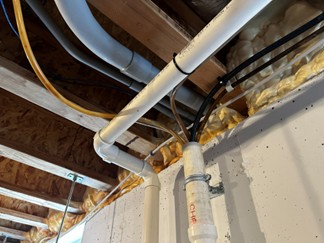
While not directly exposed to the airstream, condensate piping can contribute to mold growth if water is allowed to stagnate within the system. Flexible PEX piping that sags and traps water can create persistent wet conditions, increasing the potential for microbial growth over time. Providing rigid, properly sloped condensate piping promotes complete drainage and eliminates standing water, supporting overall system cleanliness.
Photo: Condensate lines from mechanical equipment discharging to main waste line. Flexible PEX can sag and accumulate standing water. Discoloration is due to mold growth
Controls
System operation plays a significant role in moisture management within the air handling unit.
Continuous low‑speed fan operation can help reduce moisture accumulation by maintaining air movement across coil surfaces, even when active heating or cooling is not occurring. This approach supports more consistent drying of internal components. Continuous low-speed fan operation does not use excessive energy because modern fans are highly efficient.
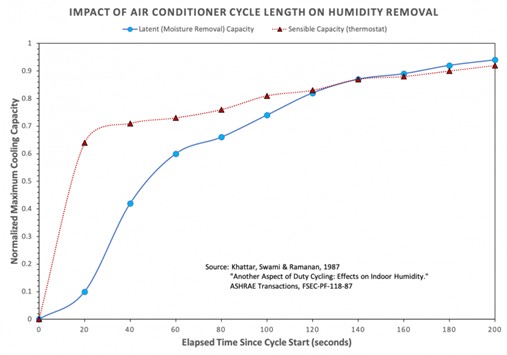
Figure from: Warehouse Temperature and Humidity Monitoring
Variable-speed compressors also play a role in limiting moisture within air handler units. Their ability to fluctuate fan speed to match the actual load, rather than cycling on and off at full output, helps to maintain longer, steadier run times. Extended operation keeps air moving across the evaporator coil, increasing moisture removal and reducing the repeated wet and dry cycling that can contribute to microbial growth within the air handler. When a unit’s cooling capacity is properly matched to the building’s sensible and latent loads, the system can satisfy humidity requirements without short cycling. This results in more consistent dehumidification, improved coil drying behavior, and fewer periods where residual moisture is left behind on internal components
Controllers that integrate both temperature and humidity sensing provide additional protection against mold growth. When AHUs are paired with dedicated dehumidification equipment, controls allow moisture to be addressed independently of sensible cooling demand. Coordinating air handler and dehumidifier operation helps maintain stable humidity levels while avoiding competing fans within the system.
Ductwork
Ductwork cleanliness is as important as air handler design, as it serves as the primary pathway through which conditioned air is delivered to occupied spaces. Particulates that accumulate within the duct system are redistributed throughout the home during normal operation, directly affecting indoor air quality. Flexible ductwork can present challenges in mold‑conscious designs due to its corrugated interior surface, which provides more opportunities for dust accumulation and moisture retention. When dampened, these pockets of dust and particulate build up can support microbial growth. Rigid metal ductwork offers a smoother, more durable surface that is less likely to trap particulates and is generally easier to keep clean over time. For applications where indoor air quality is a priority, minimizing flexible duct runs and favoring rigid duct systems can support cleaner air delivery and long‑term system performance.
Accessory Equipment
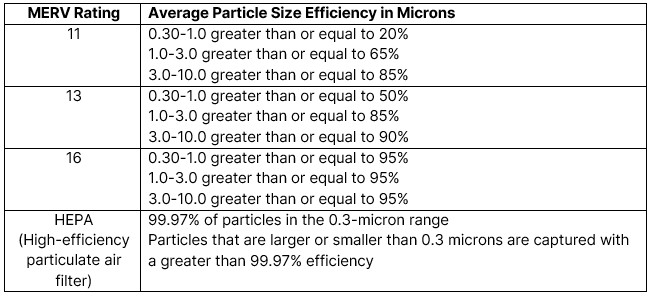
Filtration is the best way to manage airborne particulates within a forced‑air system. Upgrading to higher‑efficiency filters, such as MERV-13 to 16 or HEPA (High-Efficiency Particulate Air), improves the system’s ability to capture fine particles that can contribute to indoor air quality concerns. Higher efficiency filters will force fans to work harder to move air through these filters; Designers should take care to account for the increased pressure drop when specifying the filter grade, selecting equipment, and designing ductwork. For residential applications, selecting the highest‑efficiency filter the air handler can reliably support helps balance filtration performance with system longevity.
Supplemental air‑cleaning technologies are sometimes incorporated to further address microbial concerns such as Ultraviolet germicidal irradiation (UV‑C). These lights are most effective when targeted at stationary components such as cooling coils where adequate exposure time can be achieved. When UVGI technology is installed in ductwork, airstreams typically pass too quickly, and the light does not have enough time to kill and deactivate bacteria and mold. Effective purification typically requires high UV exposure levels which present safety concerns and may damage filters and equipment components. Additionally, According to the EPA, even dead mold spores can still trigger allergic reactions, and UV light cannot remove dead mold spores from the air stream. Supplemental air‑cleaning should be viewed as part of an integrated design approach rather than a standalone solution.
Ventilation
Ventilation strategy has a direct impact on indoor air quality. Older homes often relied on incidental air leakage to provide fresh air, but modern high‑performance residential construction significantly reduces natural infiltration. There is now an emphasis on the importance of air-sealing buildings. Current building energy codes set a high bar for air-sealing by mandating air-leakage testing and setting leakage limits for new construction buildings. Without intentional ventilation, stale air and moisture generated by occupants will accumulate within the home.
In mold‑conscious designs, integrating a dedicated ventilation strategy allows outdoor air to be introduced in a controlled manner. Energy recovery ventilators (ERVs) can provide continuous fresh air while limiting the introduction of excess moisture by transferring both heat and moisture between the incoming and exhaust air streams. When properly designed, ERV systems support indoor air quality goals without increasing the moisture burden on the air handler.
Dehumidification
Standalone dehumidifiers can provide an added layer of moisture control, particularly during periods when latent loads are high, but sensible cooling demand is low. By addressing humidity independently of temperature, dehumidification helps limit moisture accumulation within the air handling unit and associated ductwork.
When integrated with air handler controls, dehumidifiers can operate in coordination with the HVAC system rather than in opposition to it. Configurations that draw air from the main return and discharge it back into the return allow moisture to be removed from the airstream before it reaches the air handler, reducing the likelihood of wetting air handler internal components. Coordinated control strategies that activate dehumidification based on indoor relative humidity further support stable moisture conditions without relying solely on cooling operation.
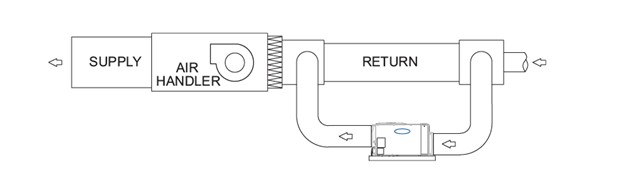
Photo: Main Return to Main Return Dehumidifier Configuration
Source: AprilAire E080 Specification Sheet
As residential buildings become tighter and expectations for indoor air quality increase, reducing the chances of mold growth within forced‑air HVAC systems should be viewed as a design consideration rather than a maintenance issue. Moisture exposure, material selection, system configuration, and control strategies collectively influence long‑term system cleanliness and performance. Addressing these factors early with thoughtful design will help to limit conditions that support microbial growth. Ultimately, clean and durable air handling systems are the result of intentional design decisions that anticipate how moisture and air will move through the system over its lifetime.
More Articles From...
| This Category | MEP, Residential Engineering |
| This Author | Ali McNamara |