
PRESERVATIVE/PRESSURE TREATED WOOD AND ITS EFFECTS ON CONNECTORS
By Team Engineering
Preservative/pressure treated (PT) wood is commonly used when wood is exposed to the elements or in contact with the ground; however, it can also have the unintended consequence of corroding materials with which they are incompatible. To understand how best to guard against this, we first must look at where PT wood is being used and what that means for the metals involved. The main reasons for choosing pressure/preservative treated lumber are based around the environmental circumstances or the structural purpose of the wood. It is proven to be a high performing and cost-effective choice for a structurally critical member or for use in an exterior, wet, or insect-susceptible location.
The process of treating Southern Pine (the most common treated wood species in the United States) and other lumbers consists of placing the wood into a cylinder and pressurizing it, which forces the preservative into the wood cells. There are two main kinds of preservatives: waterborne and oilborne. Waterborne preservatives produce minimal odor and have a dry, paintable surface after the treatment. They also often contain copper, and because water is added to the wood during the process, drying and shrinkage can occur in the wood unless it is kiln dried after the treatment. Oilborne preservatives are typically used to treat glue laminated wood because they don’t swell the wood, but heavy oil treatments should not be used inside a habitable building because of the possibility of unpleasant odors.
For waterborne preservatives, Inorganic Boron (SBX) can be used for interior or above-ground purposes where it is protected from liquid water. Propiconazole Tebuconazole Imidacloprid (PTI) is typically used in above-ground applications along with Ecolife (EL2). Micronized Copper Azole (MCA & MCA-C), Copper Azole (CA-C), and Alkaline Copper Quat (ACQ) can all be used above-ground, and in contact with the ground or fresh water. Chromated Copper Arsenate (CCA-C) is typically used for permanent wood foundations for one- and two-family residences, but can be used in other commercial applications such as highways, industrial and utility areas, marinas, and other severe environments.
So, what does this have to do with fasteners? Preservatives used in PT wood can be chemically incompatible with metal and cause the fasteners to erode faster. This is particularly true for the newer preservatives Alkaline Copper Quat and Copper Azole, which were developed to replace Chromated Copper Arsenate. Therefore, when selecting a coating for fasteners, there are a few things you should consider:
- What are the corrosion conditions? There is Dry Service, which is usually interior lumber, or wood falling into UC1 or UC2. UC refers to the Use Categories, which are created by the American Wood Protection Association or AWPA. UC1 and UC2 are
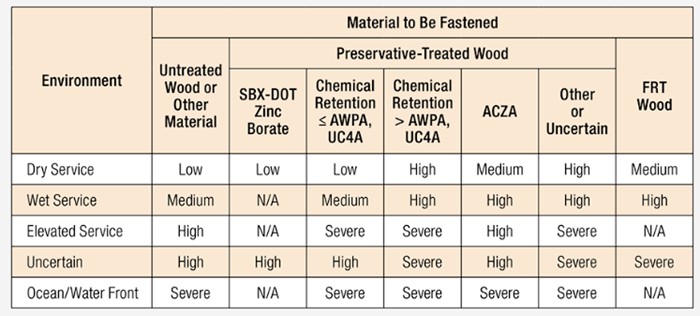
- Once you’ve determined the corrosion conditions, you can then consider the wood that is being fastened. Simpson Strongtie offers a table on Corrosion Resistance Classification which delves into the Use Category System and the types of preservatives being used in the wood.
Figure 1 – Simpson Strongtie’s Corrosion Resistance Classification https://www.strongtie.com/solutions/corrosion/wood-connectors-fasteners
Chemical retention is the amount of active ingredients from the preservatives that remained in a specific zone of the wood after the treatment, measured in pounds per cubic foot of wood. The AWPA has regulations for the minimum retention for each use case in different woods with different treatments. The table above refers to whether the chemical retention is less than or more than the specified retention of UC4A. This category is typically for members in contact with the ground or fresh water, or that are structurally critical. Knowing this, you can determine if your lumber is in a category below or above it and decide which column to use. The other column headers are referencing specific types of treatments or other materials.
3. By referencing the use categories and understanding what type of treatments might be used when, you can refer to the table to get a sense of what level of corrosion resistance you will need. Once you have that, you can decide what type of coating your connectors and fasteners need. It is important to match compatible coatings for connectors and fasteners that will be connected, otherwise this can cause galvanic corrosion or other issues. Galvanic corrosion can happen when electrochemically dissimilar metals contact each other, and water or another electrolyte creates a conductive path for metal ions to move from one metal to the other. Check the manufacturer’s website for more information on what coatings and materials are offered and which are compatible.
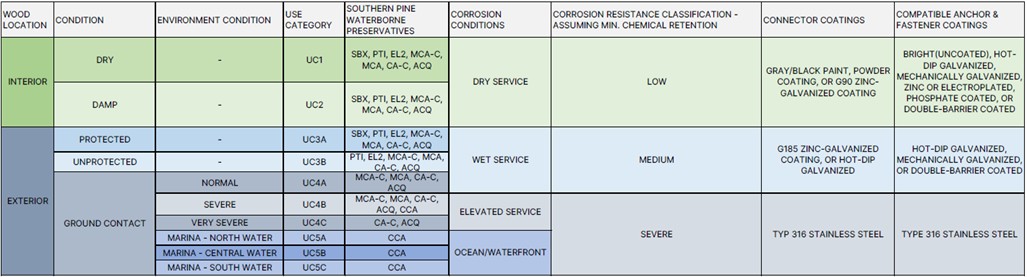
table below is a resource that you can use to estimate the appropriate connector and fastener coatings or materials for your project. Start by identifying the location of your lumber and the conditions it will be exposed to. Then, determine the approximate use category, which will inform the selection of preservatives. Finally, consider the coatings and materials that could be used.
More Articles From...
| This Category | Structural Design, Structural Engineering |
| This Author | Team Engineering |